
Why Am I Anxious When Nothing Is Wrong?
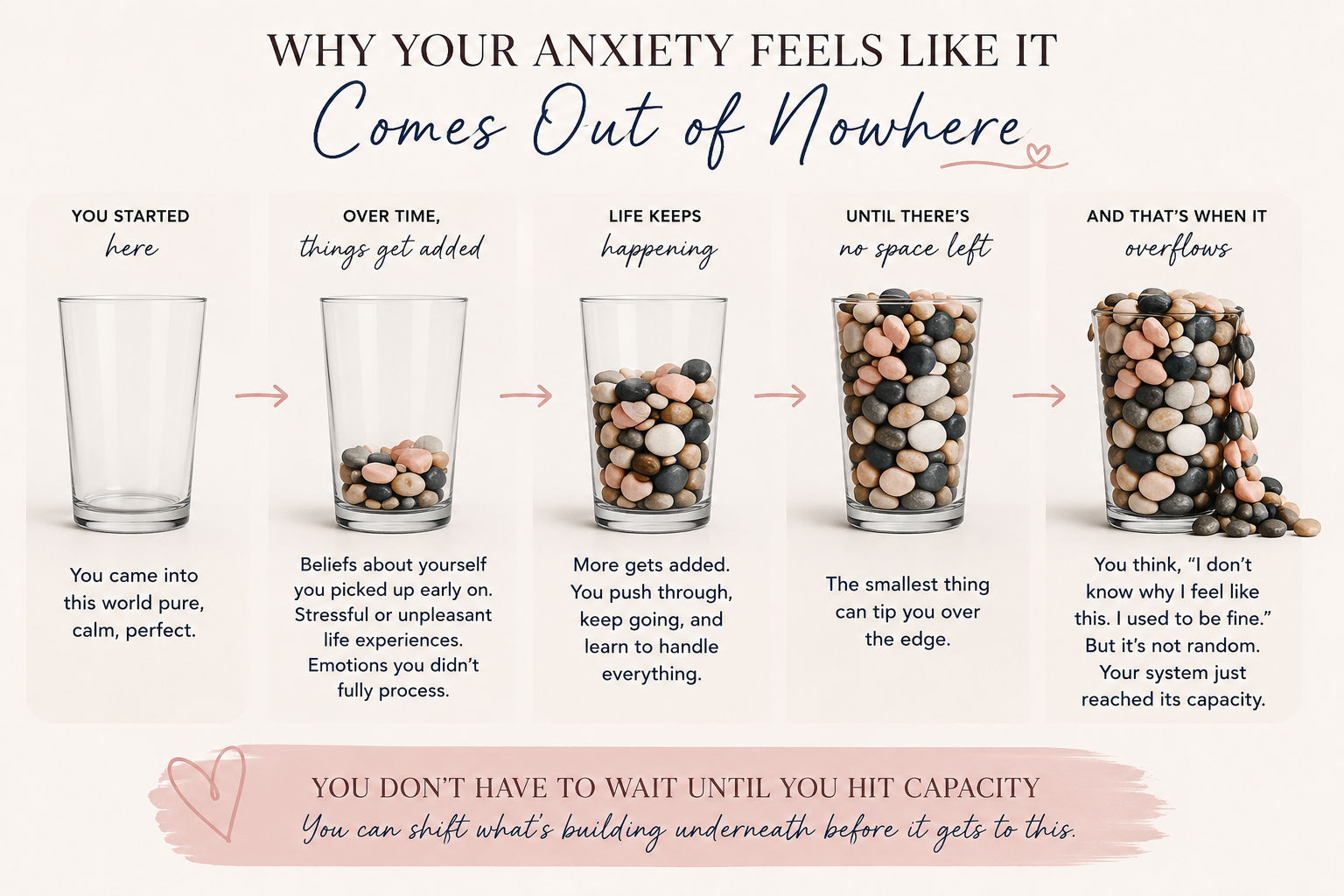
One of the most confusing experiences with anxiety is when it seems to appear for no obvious reason. You can look at your life and think, Nothing is actually wrong, so why do I feel like this? Your work may be going well, your relationship may be safe and there may be no immediate crisis. Yet your body feels tense, your mind keeps searching for something to worry about and even small things can suddenly feel overwhelming.
Anxiety can feel as though it has come out of nowhere. Often, however, it reflects things that have been building quietly over time.
The Glass May Have Been Filling for Years
Imagine that a glass represents your emotional and nervous system capacity.
From early in life, experiences, relationships and the meaning you make of them begin shaping what you carry and how you respond. You may develop beliefs such as:
I am not good enough.
I have to be strong.
I cannot let people down.
I need to keep everything together.
Then life adds more. There may be difficult relationships, loss, pressure, responsibility and emotions you did not have the time or space to process because you needed to keep functioning. If you are accustomed to being capable, responsible or the person everyone else depends on, you may become very good at pushing through. You function and keep moving. But getting through something does not always mean it has stopped affecting you.
You may have learned to remain alert because life once felt unpredictable. You may have become overly responsible because nobody else seemed to be. Perhaps you suppressed anger because conflict felt unsafe, kept achieving because success helped you feel valued or minimised your needs because other people always seemed to need more from you.
These patterns may not resemble anxiety. They may simply feel like your personality. You might describe yourself as responsible, driven, organised or independent. These can be genuine strengths, but when they are driven by fear or the belief that you can never safely stop, they can consume enormous emotional energy.
The Final Drop Is Not the Whole Story
Life does not stop adding pressure simply because you are coping. There is another stressful period, another responsibility, another disappointment or another demand at work. You tell yourself you will deal with it later and continue doing what you have always done. Eventually, there is very little room left.
Then something seemingly small happens. Someone speaks to you sharply. You make a mistake. A person does not reply to your message. You wake up feeling physically different. You have a difficult day at work or feel exhausted after a poor night’s sleep. Suddenly, you feel as though you cannot cope.
This is often when people say, I don’t understand. I used to be fine. Or, Nothing even happened. Why am I so anxious?
We tend to focus on the final thing that happened. We look at the last drop and assume it must have caused the overflow. But when a glass is already full, it does not take much to exceed its capacity. The event that seemed to trigger the anxiety may simply have occurred when your emotional capacity was already stretched. This is why the intensity of the response can feel disproportionate to what is happening in the present. It may reflect everything that has been accumulating underneath.
Why Coping Strategies May Stop Feeling Like Enough
Many of the people I work with reach out when the strategies that once helped stop working. Their body becomes more reactive, their mind is harder to switch off and they feel tired, overwhelmed or constantly on edge. They begin wondering what happened to the person they used to be.
That capable person has not disappeared. They have been carrying too much for too long without having the opportunity to address what sits underneath.
Breathing and grounding techniques can help settle an immediate response, but they may not change the patterns repeatedly filling the glass. You don’t have to wait until you reach breaking point before seeking help.
Looking at What Has Been Filling the Glass
When I work with anxiety, I am not interested only in the moment the glass overflowed. I want to understand what has been filling it. What have you learned about responsibility, safety, worth or control? What emotional experiences did you push aside because you needed to keep functioning? What patterns are still operating today, even though your circumstances may now be very different?
Anxiety may be the most visible problem, but it does not always reveal what is contributing underneath. Anxiety can also be influenced by physical health, hormonal changes, medication, sleep and other factors, so new or concerning symptoms should be appropriately assessed. When emotional and protective patterns are contributing, therapeutic work can help us understand why the mind and body continue responding as they do.
My approach combines Rapid Transformational Therapy®, clinical hypnotherapy, conversational hypnosis and Somatic Trauma-Informed Coaching techniques. I adapt the work to the beliefs, emotional experiences and protective responses relevant to each client.
The aim is not simply to help you tolerate a full glass more effectively. It is to understand what has been filling it so that the patterns driving the anxiety can begin to change.
Looking for Help With Anxiety?
I am Julie Chal, a Rapid Transformational Therapist, anxiety specialist and Clinical Hypnotherapist based in Perth, Australia. I work with clients in Perth and online across Australia and internationally.
If your anxiety seems to have appeared unexpectedly, or you feel as though you have spent years holding everything together and have now reached your limit, my Tranceform Anxiety to Thrive program is designed to explore and work with the deeper patterns contributing to your anxiety.
The first step is a 50-minute Consultation Call, where we discuss what you are experiencing and whether my approach is appropriate for you.